LLM SEO guide · Updated November 9, 2026
LLM SEO: how to get named and cited in AI answers
LLM SEO is the work of getting large language models such as ChatGPT, Claude, Perplexity, Grok and Google’s AI Overviews to name your brand and cite your pages when buyers ask. Each one searches its own way, so open your site to their crawlers, publish answers they can quote and earn mentions on the pages they already read.
7 days free. No card required.
Slibur tracks ChatGPT
 Claude
 Google AI
 Perplexity
 Grok

What LLM SEO means, and the other names for it
Same goal, many labels: get named and linked when an AI answers a buyer’s question.
A buyer used to type a query and scan ten links. Now many ask ChatGPT or Perplexity, or read the AI Overview at the top of Google, and get one written answer. In the reading further down this page, each answer named four to seven brands. If you are not one of them, the comparison happens without you.
LLM SEO is how you get into it. Most of the work looks familiar: pages a crawler can read, plain answers, mentions on sites people trust. What changes is who reads them. Five AI platforms, each with its own search, its own crawler and its own taste in sources.
SEO for LLMs. The plain-English version of the same idea.
LLMO or LLM optimization. Common in marketing. Engineers use it for making models faster, which is another subject.
GEO. Generative engine optimization: the term used in academic papers and by many agencies.
AEO. Answer engine optimization: older, born with featured snippets and voice assistants.
AI SEO. Broad. Sometimes it means this; sometimes it means using AI to write content.
Classic SEO vs SEO for LLMs: what changes
The foundations carry over. The prize, the referee and the scoreboard do not.
Scroll sideways to see every column.
| What changes | Classic SEO | SEO for LLMs |
|---|---|---|
| What you compete for | One of ten links on a results page | A mention or a cited link inside one written answer |
| Who picks the winner | A ranking system that orders pages | A model that reads search results, or its memory, and then writes |
| How stable it is | Positions drift over days or weeks | Ask twice and the list of brands can change |
| Where you can win | Mostly on your own pages | On your pages and on every page that talks about you |
| What you track | Rank, impressions and clicks | How often you are named, your place in the answer and the pages cited, per AI |
| What carries over | Crawlable pages, plain answers, links from sites people trust | All of it, now read by five systems that search in different ways |
The upshot: an LLM SEO plan is a classic SEO plan plus two jobs it never had. Checking what each AI actually answers, and working on pages you do not own.
How each of the five AIs finds the pages it cites
From each company’s own documentation, read on November 9, 2026. None of them publishes how it ranks one source above another, but they do say how they search and which crawler decides whether you can be found.
Scroll sideways to see every column.
| AI platform | How it gets fresh facts | Crawler that matters | What its own docs say | How Slibur reads it |
|---|---|---|---|---|
| ChatGPT | With search on, it looks things up on the web and links the pages it used. In our reading it ran one search per question. | OAI-SearchBot for search. GPTBot only feeds training, and ChatGPT-User opens pages when a person asks. | Block OAI-SearchBot and your pages drop out of ChatGPT’s search answers, except as plain navigational links. Robots.txt edits need about 24 hours to take effect. | Read on chatgpt.com, logged out, every day* |
| Google AI Overviews | Built on Google Search. It can run several related searches (query fan-out) and shows up only on some queries. | Googlebot. Google-Extended covers training and grounding in other Google systems, not Search. | A page must be indexed and eligible for a snippet. Google lists no extra files, AI text files or special markup to appear. | The Overview above real Google results, every day |
| Claude | Decides per question. It searches for prices, products and recent news, and answers settled facts from memory. | Claude-SearchBot for search and Claude-User for requests a person makes. ClaudeBot is the training crawler. | Blocking Claude-SearchBot may reduce how visible your site is in its search results. Citations are always on in its web search tool. | Its model with web search, through OpenRouter, every week |
| Perplexity | Search is the product: its API looks things up for every question. In our reading it cited 14 to 18 sites per answer, more than any other AI. | PerplexityBot. Perplexity-User fetches a page when someone asks and generally ignores robots.txt. | Allow PerplexityBot in robots.txt and its published IP ranges in your firewall. It is not used to train foundation models. | Its API, which always searches, every week |
| Grok | Through xAI’s API, Grok can search and browse the web in real time, and a separate X Search tool reads posts on X. | The xAI tool pages read for this guide name no crawler to allow. | Its web search can be held to, or kept away from, up to five domains, and answers come back with citations. | Its model with web search (not X Search), through OpenRouter, every week |
* On paid plans. ChatGPT is read on chatgpt.com in every country Slibur tracks except Venezuela and Puerto Rico, where it is asked weekly through its API.
What it means for you. Five crawlers decide whether you can be found, and each blocks you separately. A robots.txt written years ago for Googlebot alone can let Google in and keep the other four out, or the reverse. Checking all five is the first job of any LLM SEO audit.
Step-by-step guides for single platforms: how to rank in ChatGPT, how to rank on Perplexity, how to rank in AI Overviews, how to rank in Claude and Grok SEO.
Three buyer questions, five AIs: what they cited on November 9, 2026
On , Slibur’s measuring engine asked all five AIs three buyer questions, from the United States and in English. 14 answers came back, and we counted every site each one cited.
84%
of the 81 sites cited across the three questions were cited by one AI only.
3 of 5
the most AIs that cited the same site for any one question. No site was cited by four or five.
2
brands named by all five for the payroll question: Gusto and OnPay.
1 of 3
questions got no AI Overview from Google. Claude also answered one question without searching.
Scroll sideways to see every column.
| Question | AIs that answered | Different sites cited | Cited by one AI only | Most shared sources | Brands every AI named |
|---|---|---|---|---|---|
| “What is the best payroll software for a company with 15 employees?” | 5 of 5 | 29 | 26 | adp.com, g2.com and techrepublic.com, cited by two AIs each | Gusto and OnPay |
| “Best noise cancelling headphones under $200” | 4 of 5 | 20 | 16 | rtings.com, cited by three AIs | JBL Live 780NC |
| “Best CRM for a small real estate team” | 5 of 5 | 32 | 26 | zapier.com, cited by three AIs | None. Follow Up Boss, Wise Agent and Pipedrive were named by four of five. |
The brands agreed. The sources did not. Gusto and OnPay were named by all five AIs for the payroll question, yet no payroll source was cited by more than two of them, and 68 of the 81 sites cited across the three questions (84%) were used by a single AI.
ChatGPT had a shortlist before it searched. Its one search for each question already contained four or five brand names. A brand the model knows from training gets looked up; one it does not know has to be found by the search itself.
ChatGPT linked the vendors it named. Three of its seven payroll sources and five of its eight CRM sources were the named brands’ own websites. Perplexity linked none of the payroll brands it named, and only two of its 18 CRM sources were theirs.
Claude skipped the search once. For “What is the best payroll software for a company with 15 employees?” it answered from what it already knew and cited nothing, which fits Anthropic’s note that Claude decides when a question needs the web.
Google stayed quiet once. “Best noise cancelling headphones under $200” showed no AI Overview at all. Google says Overviews appear only when its systems judge they add something to the regular results, so some of your questions will never have one.
What ChatGPT searched for
One search per question, written by ChatGPT before it read anything:
Payroll
best payroll software for 15 employees small business 2026 Gusto QuickBooks Payroll ADP RUN OnPay pricing features
Headphones
best noise cancelling headphones under $200 2026 reviews comparison Sony Bose Anker JBL
CRM
best CRM for small real estate teams 2026 pricing features Follow Up Boss Wise Agent LionDesk Real Geeks HubSpot
Every site each AI cited, question by questionShow
“What is the best payroll software for a company with 15 employees?”
- ChatGPTgusto.com, onpay.com, technologyadvice.com, adp.com, fitsmallbusiness.com, unpackmoney.com, stackbytrade.com
Its search also returned, without citing them: inc.com, hackceleration.com, softwarecompare.net, growthstacked.io, moneysimple.org, payrollrate.com, guides.reviews, techradar.com, onpay.com, help.onpay.com, gusto.com.
- Google AI Overviewshackceleration.com, g2.com
- ClaudeIt linked to no sources in this answer.
- Perplexitypcmag.com, keka.com, Rankite, paycom.com, techrepublic.com, softwareadvice.com, niural.com, forbes.com, zoho.com, capterra.com, g2.com, selectsoftwarereviews.com, rho.co, tech.co, warp.co, adp.com, workforce.com
- Grokfridayapp.com, betterbuys.com, hrstacksolutions.com, acenteus-cca.com, techrepublic.com, hawaiipayrollguide.com
“Best noise cancelling headphones under $200”
- ChatGPTrtings.com
Its search also returned, without citing them: rtings.com, pickedtech.com, tomsguide.com, soundguys.com, rtings1.com, ratingmobile.com.
- Claudertings.com, soundguys.com, recordingnow.com, cnn.com
Its search also returned, without citing them: rollingstone.com, hiconsumption.com, en.wikipedia.org, recordingnow.com, comfortalife.com, tech.yahoo.com.
- Perplexityrtings.com, cnn.com, tomsguide.com, pcmag.com, soundguys.com, recordingnow.com, consumerreports.org, mashable.com, crutchfield.com, headphonesaddict.com, musiccritic.com, techradar.com, courant.com, sweetwater.com
- Grokpwice.com, theclassicalshop.net, audiofavorite.com, progressiveradionetwork.com, knowledgelib.io, bygrinstow.com
“Best CRM for a small real estate team”
- ChatGPTzapier.com, followupboss.com, stacknpilot.com, wiseagent.com, HubSpot, realgeeks.com, leadsync.me, lofty.com
Its search also returned, without citing them: toolcurrent.tech, adagemarketers.com, softwarecompare.net, bestcrmpick.com, wireranked.com, housingwire.com, spotsaas.com, crmverdict.com.
- Google AI Overviewsyoutube.com
- Clauderealscout.com, luxurypresence.com, housingwire.com, quickbase.com, zapier.com, sonary.com
Its search also returned, without citing them: alternativeto.net, learn.g2.com, g2.com, cbinsights.com.
- Perplexityparseur.com, housingwire.com, wiseagent.com, zapier.com, quickbase.com, capterra.com, zdnet.com, nethunt.com, freshworks.com, sharplaunch.com, hostinger.com, HubSpot, business.com, realscout.com, monday.com, creatio.com, forbes.com, zoho.com
- Grokhackceleration.com, tower-crm.com, growthtechspotlight.com, aframesoftware.com, crmdaily.co, propphy.com
In bold, sites cited by more than one AI for that question.
How we asked
- ChatGPT: read on chatgpt.com, logged out, with web search on, with gpt-6.
- Google AI Overviews: the AI Overview Google shows above its results.
- Claude: asked through its API with live web search, with claude-haiku-5-5.
- Perplexity: asked through its API, which always searches, with sonar.
- Grok: asked through its API with live web search, with grok-4.3.
One run per AI and question, between 18:18 and 18:23 UTC, with no brand in the question. Brand names were checked by hand against each answer (plans and variants of one product count once). Links that go through google.com redirects are left out, because they do not show the site behind them. Three questions are a snapshot, not a study. Ask again tomorrow and some names and sources will differ, which is why step 2 below asks for several days. The answer texts are not reproduced here.
The lesson for LLM SEO. Being known gets you onto the shortlist; being on the pages each AI reads keeps you there. Since the five barely share sources, the outreach list for ChatGPT is not the list for Perplexity, and neither is Grok’s.
How to optimize for LLMs: 8 steps
None of them is a trick. Together they make your brand easy for every AI to find, read and quote.
List the questions that bring in buyers
Write down 10 to 20 questions people ask right before they pick a provider like you: “which X is best for Y”, “X or Y for a team of 10”, “cheaper options than Y”, “how much does X cost in Z”. Leave your own name out and keep the detail you win on, such as team size, budget, use case or city. These prompts are the scoreboard for every other step. Stuck for ideas? Our free AEO prompt generator drafts a first list from your site.
Take a baseline in all five AIs
This is your LLM SEO starting point. Put each question to ChatGPT, Google (look for the AI Overview), Claude, Perplexity and Grok, logged out, and write down who is named, in what order and which pages are linked. Repeat on two or three different days. One answer is a sample; a pattern across runs is a result.
Open the door to each search crawler
Allow OAI-SearchBot, Googlebot, Claude-SearchBot and PerplexityBot in robots.txt, then check that your CDN, firewall or bot protection does not challenge them. Blocking the training crawlers (GPTBot, ClaudeBot, Google-Extended) is a separate decision and does not take you out of their search answers. Our free AI crawler checker tells you which of them your robots.txt lets in.
Put your facts in the HTML as text
A model can only quote what its crawler receives. Prices, plans, service areas and specs that load through JavaScript, sit inside images or need a login tend to go missing. Give each key fact a line of plain text near the top of the page that owns it, and keep structured data consistent with what the page shows.
Write passages a model can lift
Give every buyer question its own section: a heading that matches the question, the answer in the first sentence, then the specifics, such as numbers, names, dates and who it suits. A paragraph that still makes sense when quoted on its own is the easiest one to cite.
Earn a place on the pages each AI reads
Your baseline shows which review sites, comparison articles, directories, forums and publishers each AI leans on for your topic. Start with those that recommend competitors but leave you out, and get listed, reviewed or quoted there. Expect a different list per AI: in our November reading, most cited sites were used by one AI only. More on finding them in AI citation tracking.
Tell the same story everywhere
Use one company name, one category, the same prices and the same product names on your site, your listings, your social profiles and your press kit. When sources disagree, an answer can repeat the outdated version, or leave you out.
Change one thing, then measure per AI
Note what you changed and the date, then rerun the same prompts for two to four weeks. Read every AI on its own: OpenAI puts the delay before a robots.txt change reaches ChatGPT search at about 24 hours, while Google says a recrawl can take anywhere from several days to several months. Our guide covers how many answers it takes to trust a change.
See what AI can read on your website
We run 18 checks on what helps AI assistants find, read and cite your site, and tell you what to fix first.
Ready as soon as you sign up, included in the free trial.
No account? Free GEO audit tool: the same 18 checks, without signing up.
LLM SEO mistakes that waste time
Six shortcuts that cost effort and win nothing, or backfire.
A special file or schema as a switch
Many LLM SEO guides call FAQ and HowTo schema essential. Google’s page on AI features disagrees: appearing there takes neither an extra file nor a special schema.org type. Keep structured data true to the page and move on. An llms.txt costs little to publish, but none of the crawler and search pages in our sources presents it as a way in. See whether llms.txt works.
Hidden lines for the bots
Text that tells models to recommend you, tucked away where people cannot see it, is hidden text under Google’s spam policies, and it reads as manipulation to any buyer who finds it.
A page for every prompt
Hundreds of near-copies, one per question, match Google’s description of scaled content abuse. A thin page that repeats what ten others say gives no model a reason to quote it, and it can pull down the search rankings AI answers draw on.
Blocking every AI bot at once
A blanket block on AI user agents also stops the search crawlers, and with them your place in ChatGPT, Claude and Perplexity answers. Block training if you want to, by name.
Optimizing for one AI only
LLM SEO aimed at ChatGPT alone ignores how little the five share: in our reading, they mostly drew on different sites. Work that wins one source list can miss the other four completely.
Paying for a promised top spot
No agency or tool controls what a model writes. Anyone selling a fixed position in ChatGPT or Perplexity is selling something they cannot deliver.
How to measure LLM SEO results
Rank trackers and Search Console were built for lists of links. Answers need their own five numbers.
Mention rate. The share of answers that name your brand, for each AI and across all five. This is the number most of your work moves.
Position. Where you appear in the answer’s list of brands. Named fifth is not recommended.
Citations. How often your own pages are linked as sources, and which pages they are.
Source domains. The sites each AI cites for your prompts, split into yours, your rivals’ and third parties’. This is your outreach list.
Rivals. The same numbers for the competitors buyers compare you with, because a gain only counts if it is a gain against them.
What LLM SEO tracking looks like on Starter
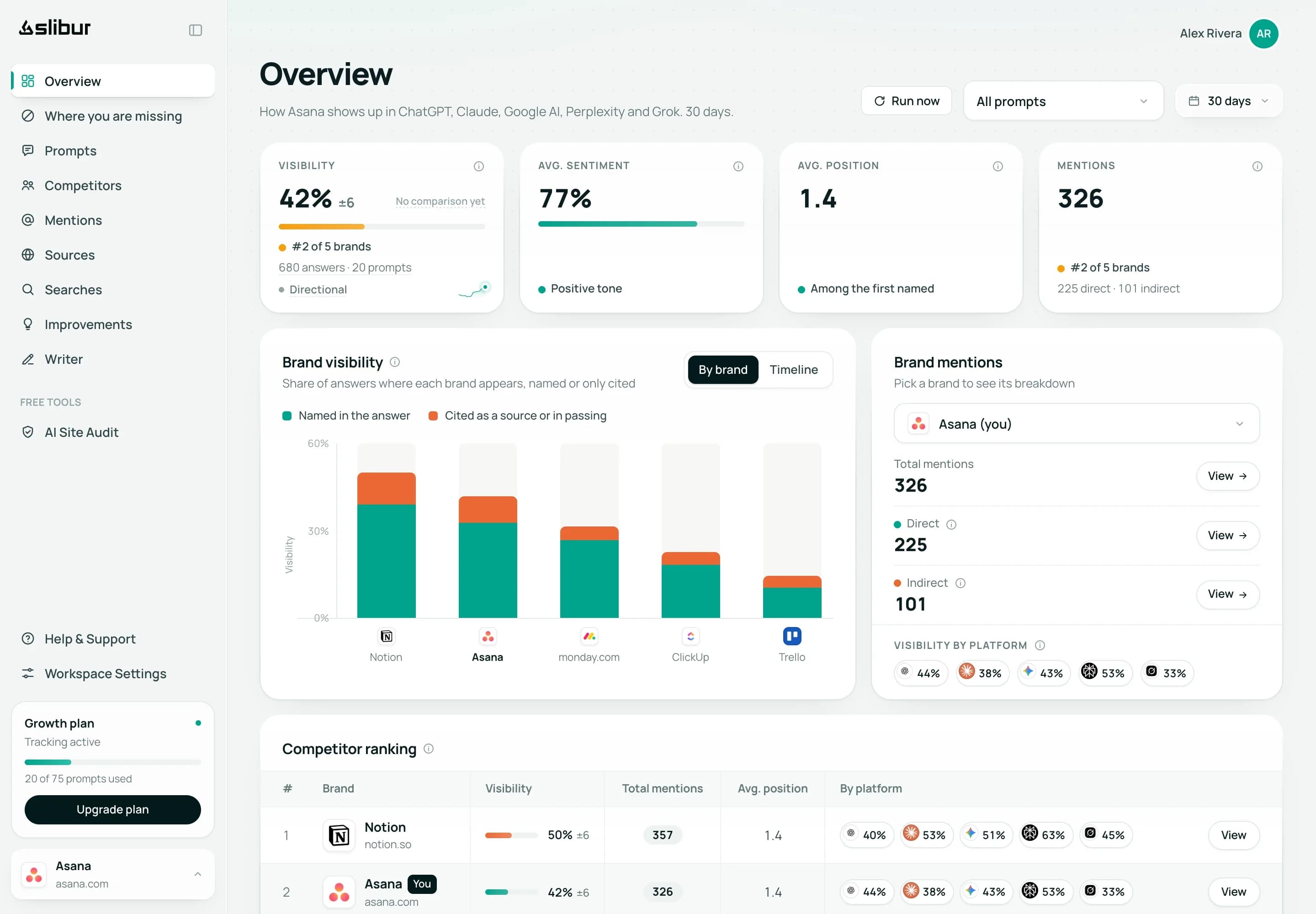
On Slibur’s Starter plan ($59 a month), your 20 prompts go to ChatGPT and Google AI Overviews daily*, and to Claude, Perplexity and Grok once a week.
1,440
answers a month, roughly, each kept in full with every page it cites.
- Your numbers next to up to 25 competitors, per AI and overall.
- 3 improvement tasks a week, drawn from what the answers show.
- 5 drafts a month from the Writer, built on what the AIs answered, for you to review.
- A weekly email, with an alert when visibility drops 10 points or more.
* On paid plans. ChatGPT is read on chatgpt.com in every country Slibur tracks except Venezuela and Puerto Rico, where it is asked weekly through its API.
And the clicks? Your analytics only hold part of the story. Clicks from AI Overviews are included in the overall Web search traffic of Search Console’s Performance report, according to Google’s documentation (opens in a new tab), so they sit mixed with your classic results. For the other four, look in your analytics for visits that come from chatgpt.com, claude.ai, perplexity.ai and grok.com, and read that figure as a floor: an answer can name you and send nobody.
Why so many answers? The same prompt can name different brands from one run to the next, so a single check proves little. Our GEO performance monitoring guide explains how often to measure, and LLM visibility tools compares which models each tracker covers.
Free checks before you start
No sign-up. Run them before step 3.
- AI crawler checkerSee whether OAI-SearchBot, Claude-SearchBot, PerplexityBot and the training crawlers may read your site.Use it free
- Free GEO audit toolRun the 18-point AI-readiness audit on any URL and get the fixes ranked by impact.Use it free
- ChatGPT sourcesList the pages ChatGPT cites for one question, and see whether any of them is yours.Use it free
Read all five AIs, free for 7 days
Your first answers from all five AIs arrive on sign-up day, so you know who they name and which pages they trust before you touch a single page.
7 days free, no card. Sign up with your email or Google. When the trial ends, tracking stops and nothing is charged.
Up to 10 prompts. We suggest prompts and competitors from your website, and you edit the list before the first run.
All five AI platforms on day one. ChatGPT, Google AI Overviews, Claude, Perplexity and Grok answer your prompts as soon as your email is confirmed.
ChatGPT and Google AI again every day while you keep visiting your dashboard. Claude, Perplexity and Grok are asked once, at sign-up.
One “Run now” and the 18-point site audit. After the trial, our free GEO audit tool still audits any site, without an account.
On paid plans only: team invites and the weekly email summary with alerts.
* On paid plans. ChatGPT is read on chatgpt.com in every country Slibur tracks except Venezuela and Puerto Rico, where it is asked weekly through its API.
Slibur Starter
Track 20 prompts on 5 AI platforms
$59/ month (USD)
Or $602 billed yearly · save $106
Start your 7-day free trial7 days free. No card required.
- Up to 20 prompts, about 1,440 answers a month
- ChatGPT, Google AI Overviews, Claude, Perplexity, Grok
- ChatGPT and Google AI every day*, the other three every week
- Competitor ranking (up to 25 rivals) and every cited URL
- Weekly improvements, plus an email summary with alerts
- 18-point AI-readiness site audit
- Up to 2 team members
Need more prompts? Growth is $129 a month for 75 and Scale $299 for 250. Compare all plans
Sources for this guide
Read on : OpenAI’s crawler documentation (opens in a new tab); Google Search Central on how its AI features treat websites (opens in a new tab) and its spam policies (opens in a new tab); Anthropic’s article on its crawlers (opens in a new tab) and the Claude web search tool docs (opens in a new tab); Perplexity’s crawler documentation (opens in a new tab); and xAI’s pages on Grok’s web search (opens in a new tab) and X Search (opens in a new tab) tools. The answers come from Slibur’s own reading on the same day. The rest is practical advice: no AI platform publishes how it ranks brands.
Questions about LLM SEO
About Slibur itself? Read the full FAQs or see every plan and price.
What does LLM SEO mean?
LLM SEO means optimizing your site and your presence around the web so that large language models such as ChatGPT, Claude, Perplexity, Grok and Google’s AI Overviews mention your brand and link your pages when they answer. You will also see it called SEO for LLMs, LLM optimization, generative engine optimization (GEO) or answer engine optimization (AEO).
How do you rank in LLMs?
There is no ranked list inside a model. To rank in LLMs is to be named, high up, in the answers to the questions your buyers ask. Let the search crawlers in, answer those questions plainly on your own pages, get onto the review and comparison pages each AI cites, and keep your facts the same everywhere. Then check the same prompts for a few weeks.
What is LLMO, or LLM optimization?
In marketing, LLMO (LLM optimization) and LLM search optimization are other names for LLM SEO: the work of showing up in AI answers. Engineers use “LLM optimization” for something unrelated, making a model run faster or cheaper through quantization, batching or caching. If you came here for that, this guide is not about it.
Does classic SEO still matter for LLMs?
Yes. Google’s own guidance is that standard SEO is all a page needs for its AI features, and the other four AIs build many answers from web searches too. The difference is what you win: a mention inside an answer, often next to rivals, and sometimes on a page you do not own.
Can I block AI training and still appear in AI answers?
Yes, by name. OpenAI separates GPTBot (training) from OAI-SearchBot (search), Anthropic separates ClaudeBot from Claude-SearchBot and Claude-User, and Google-Extended does not control Google Search. Perplexity describes PerplexityBot as a search crawler that does not collect training data. Since October 30, 2026, Anthropic has also begun recognizing a general “no AI training” preference signal, which it is rolling out across its services, though a robots.txt rule that names ClaudeBot takes priority.
Does LLM SEO work the same for Gemini, Copilot or Meta AI?
The groundwork is the same: pages their crawlers can read, plain answers and mentions on sites people trust. Each one has its own rules for crawling and search, so read its documentation before you touch robots.txt. This guide covers the five AIs Slibur reads: ChatGPT, Google AI Overviews, Claude, Perplexity and Grok. Slibur does not measure Gemini, Copilot, Meta AI, DeepSeek or Google AI Mode.
How long does LLM SEO take to work?
Technical fixes can show in days: OpenAI says robots.txt changes reach ChatGPT search in about 24 hours. New pages and new mentions on third-party sites take longer, because each AI has to find them in a search first, and what a model knows without searching only changes with a new model version. Think in weeks, and judge progress on an unchanged set of prompts.
Can an agency or a tool guarantee results in ChatGPT?
No. Nobody outside OpenAI, Google, Anthropic, Perplexity or xAI decides what their models say. What you control is how easy you are to find and quote, and you can track whether the share of answers naming you goes up.
Is there a free way to check where I stand?
Ask the five AIs your buyers’ questions yourself and note the results. To do it at scale, start a 7-day Slibur trial without a card: up to 10 prompts, answered by all five on the first day. The 18-point site audit is free with no account, and paid plans start at $59 a month.
See where your LLM SEO stands today
Enter your domain, keep the prompts Slibur suggests or write your own, and get a first LLM SEO baseline across the five AIs on day one: who gets named, in what order, and from which pages.
7 days free. No card required.