Scored checklist · Updated November 7, 2026
Generative engine optimization audit checklist
A generative engine optimization audit checklist tests two things: whether AI assistants can reach and trust your site, and what they actually answer when your buyers ask. Half the lists that rank on Google stop at the first. This one scores both, 24 checks out of 100, and says where each check comes from.
7 days free. No card required.
Slibur tracks ChatGPT
 Claude
 Google AI
 Perplexity
 Grok

What a GEO audit checklist has to cover
A generative engine optimization audit checklist needs two halves, and they fail in different ways. A site can be flawless and still be missing from the answers. It happened to our own site on November 7, 2026.
Checks 1 to 12 · 40 points
The site: can AI search reach, read and trust your pages?
Crawler access, Google’s AI setting in Search Console, indexing, text in the HTML, pages worth quoting and facts that match. You fix it once and recheck it after every release.
Checks 13 to 24 · 60 points
The answers: what do the AIs say when buyers ask?
The questions, the AIs, the runs, and what each answer records: who is named, which pages are cited, what is said about you. It changes from run to run, so you measure it again and again.
Our own site, both halves
At 12:20 UTC on November 7, 2026, slibur.com scored 100 out of 100 in our free 18-point GEO audit. Two minutes later we asked chatgpt.com the question behind this page. It cited five pages. None of them was ours. See the full reading. That is why the answers weigh 60 points here and the site 40.
The 24-point generative engine optimization audit checklist
Tick what you have done and passed. Points follow impact: what can keep you out of every answer weighs most. Each check says how to test it and where the advice comes from.
- AI vendor documentation: Google, OpenAI, Anthropic or Perplexity say it in their own documentation.
- Published research: A published paper or survey supports it, with its limits.
- Our reading, November 7, 2026: What we measured ourselves, shown further down this page.
- Common practice: No vendor documents it. It is sound measuring method.
- Shown, not scored: Listed because people ask about it, worth 0 points.
Score so far: 0 of 100. What to fix first
Your site
0 of 40 points
Can AI search reach your pages, read them and find something worth quoting? You fix this half once, then recheck it after every release or migration.
Access: can the crawlers get in?
- 6 pointsOpen yoursite.com/robots.txt. Nothing should disallow OAI-SearchBot (ChatGPT search), Claude-SearchBot (Claude), PerplexityBot (Perplexity) or Googlebot (AI Overviews and AI Mode), by name or under “User-agent: *”. GPTBot and ClaudeBot collect training data, and Google-Extended only controls Gemini training and grounding, not Search: blocking them is a separate decision. Our AI crawler checker reads the file for you.
AI vendor documentationOpenAI (opens in a new tab), Anthropic (opens in a new tab), Perplexity (opens in a new tab) and Google (opens in a new tab) crawler docs
- 3 pointsA robots.txt that says yes does not help if your CDN or bot protection answers with a 403. Search your firewall rules and logs for those crawler names. OpenAI and Perplexity publish the IP ranges their crawlers use, so you can allow them by address.
AI vendor documentationPerplexity crawler docs, with firewall rules (opens in a new tab)
- 4 pointsIn Search Console, open Settings, then Search generative AI. “Include” is the default. Check the domain property and every URL-prefix property under it, such as a blog: each one follows its closest parent unless someone changed it. The control reached every site worldwide on August 31, 2026.
AI vendor documentationSearch Console Help (opens in a new tab)
- 4 pointsRun URL Inspection on each page you want cited. It has to be indexed, with no noindex and no nosnippet. Google says that is all a page needs to be eligible as a supporting link in AI Overviews or AI Mode: there are no extra technical requirements. List each one in your XML sitemap so new pages are found quickly.
AI vendor documentationGoogle, AI features and your website (opens in a new tab)
- 3 pointsUse View Source, not the inspector, on a key page and search for its first paragraph. If the text only appears after scripts run, a crawler that does not run them reads an empty page. Our free GEO audit counts the words in the HTML your server sends: 300 or more is a pass.
Common practice
Pages: is there something worth quoting?
- 4 pointsRead the first two sentences under every heading. They should answer the question the heading asks, with the detail that changes the answer (price, size, place), before any company story. If they warm up instead, rewrite them.
Common practice
- 4 pointsOpen the top three results for the question. Write down one thing your page adds: your own numbers, a worked example, a dated test. If you cannot name one, you are offering a copy of what is already there. Google’s name for the alternative is non-commodity content.
AI vendor documentationGoogle’s guide to its generative AI features (opens in a new tab)
- 4 pointsEvery figure links to where it came from, and the page says when it was last reviewed. In the 2023 study that named GEO, adding citations, quotations and statistics lifted how much of the answer drew on a page by 30% to 40% on its benchmark. A 2026 review of 45 studies adds the limit: those gains held for pages the engine was already reading.
Published researchGEO paper (2023) (opens in a new tab) and survey (2026) (opens in a new tab)
- 3 pointsSearch Google for site:yourdomain.com plus the topic. If two of your pages answer the same question, merge them and redirect the weaker one. Dozens of near-identical pages for keyword variants are what Google’s spam policies call doorway and scaled content abuse.
AI vendor documentationGoogle spam policies (opens in a new tab)
- 3 pointsCompare your company name, prices, plan names, locations, opening hours and the people you list on your site with your Google Business Profile, review sites, directories and social profiles. Fix the oldest copy first. A wrong price on an old directory page can end up in the answer.
Common practice
Optional signals
- 2 pointsTest key pages in Google’s Rich Results Test (opens in a new tab): Organization, Product or LocalBusiness, with the same facts as the visible text. Google says structured data is not required for its AI features and there is no special markup for them. Keep it for rich results, not for citations.
AI vendor documentationGoogle’s guide, “what you don’t need to do” (opens in a new tab)
- 0 pointsA plain-text summary of your site at /llms.txt. Google says Search does not use llms.txt or any other AI-only file, AI Overviews included. If you publish one anyway, our llms.txt checker tests the format. It earns no points here, as in our free audit.
Shown, not scoredGoogle’s guide (opens in a new tab)
The AI answers
0 of 60 points
Put your buyers’ questions to the five AIs. What comes back? This half moves every week, so every check here is about measuring it the same way each time.
The questions
- 6 pointsWrite what a buyer types before they know your name: what they need, the kind of product and, if you sell locally, the city. “Best bookkeeping service for a three-person design studio” tells you something; “Is Acme Books any good?” does not. Our AEO prompts generator suggests twenty from your website.
Common practice
- 4 pointsCategory questions (best X for Y), comparisons (X vs Y, alternatives to X) and problems (how do I stop Z). Buyers ask all three, and a brand can lead one kind and be absent from the other two.
Common practice
The runs
- 6 pointsAt least ChatGPT and Google AI Overviews, plus Claude, Perplexity and Grok where your buyers use them. Do not let one stand in for another: on November 7, 2026, none of the five pages chatgpt.com cited for this page’s question was in Google’s top 10 for the same search.
Our reading, November 7, 2026See the reading
- 6 pointsUse a new chat in a private window, logged out, set to your buyer’s country and language. One answer is a single draw, and the next run can name other brands. This checklist sets three runs on three different days as the floor for a first baseline.
Published research2026 survey: run-to-run variability (opens in a new tab)
What each answer records
- 6 pointsAnswers that name you, divided by all the answers you collected. Named in 39 of 300 answers is 13%, however good the best answer looked. Keep the count for each AI as well as the total.
Common practice
- 5 pointsAnswers that link to a page on your site, divided by all answers. An AI can name you without linking to you, or cite your page without saying your name, so the two numbers move on their own.
Common practice
- 5 pointsEvery brand in each answer, in the order it appears. Put each rival’s mention rate next to yours: the gap is the size of the job, and it tells you whom to study first.
Common practice
- 6 pointsLog each URL the answers cite and mark it as yours, a rival’s or a third party’s. A review site or list that names three rivals and skips you is the most direct fix you will find: ask to be added, or give its author a reason to add you.
Common practice
- 5 pointsCheck every mention against your facts: price, plan names, features, locations. A wrong fact is a first-priority fix, and you fix it on the page the answer cited, not in the answer.
Common practice
- 3 pointsMark a mention positive when the answer recommends you, negative when it names a drawback, and leave the rest as plain mentions. Being named as the cheap option, or as the one with slow support, still counts as a mention, and a mention rate on its own would score it as a win.
Common practice
Follow-up
- 3 pointsIn Search Console, the Generative AI performance report counts the impressions your links got in AI Overviews and AI Mode, with a split by page, country and device. Google opened it to every site worldwide on August 31, 2026, and a site with few of those impressions sees no data yet. Next, filter your analytics for visits referred by chatgpt.com, perplexity.ai, claude.ai, gemini.google.com and copilot.microsoft.com. Neither shows what the answer said, so they sit next to checks 17 to 22, not in place of them.
AI vendor documentationSearch Console Help (opens in a new tab)
- 5 pointsSave every answer with its date, the AI and the exact question. Re-run the answer half every week and the site half after each release, and give every fix a name and a deadline. Without the baseline, next month’s number has nothing to beat.
Common practice
What the pages ranking for this search leave out
On November 7, 2026, we opened the nine results Google showed in the US for “generative engine optimization audit checklist”. One turned away automated visits, so we read eight: a social post, five guides, a product page and an interactive checklist, from under 300 words to over 5,000.
Scroll sideways to see every column.
| What the checklist does | Ranking pages | This checklist |
|---|---|---|
| Tells you to ask the AIs real buyer questions | 4 of 8 | Yes, checks 13 to 24 |
| Says how many times to repeat each question | 2 of 8 | Three runs on different days (check 16) |
| Keeps search crawlers apart from training crawlers | 3 of 8 | Yes (check 1) |
| Treats GPTBot, ClaudeBot or Google-Extended as crawlers AI answers depend on | 3 of 8 | No: their makers keep them apart from search |
| Presents llms.txt as required | 2 of 8 | No: shown, worth 0 points (check 12) |
| Mentions Search Console’s Search generative AI control | 1 of 8 | Yes (check 3) |
| Gives you a score | 3 of 8 | Yes, out of 100, on this page |
| Covers Grok | 0 of 8 | Yes (check 15) |
| Says how precise the resulting numbers are | 0 of 8 | Yes, in the one-week plan below |
Two gaps in all of them. None of the eight mentions Grok, and none says how far a number like a 13% mention rate can move by chance alone. A checklist that tells you to measure, without saying how precise the measurement is, leaves you guessing whether a change was real.
One common mistake. Three of the eight treat training crawlers as the ones that get you into AI answers. OpenAI says the opposite: GPTBot and OAI-SearchBot are separate settings (opens in a new tab), so you can block training and still appear in ChatGPT search.
The answer half, run on this exact question
A checklist is easier to trust once you see it used. At 12:22 UTC on November 7, 2026, we asked chatgpt.com: “What should a generative engine optimization audit checklist include?” Logged out, from the United States, in English and with web search on.
| Sources cited | 5 |
|---|---|
| Sites behind them | 4 |
| Results found and not cited | 10 |
| Background searches | 1 |
| Cited pages in Google’s top 10 for the same search | 0 |
| Google top 10 sites among the results not cited | 1 |
| slibur.com, cited or found | Neither |
Who it cited. Two pages from an SEO training site, a checklist from a fixed-price audit service, one from a growth consultancy and a July 2026 survey of GEO research (opens in a new tab) on arXiv.
What it searched for. One search: “generative engine optimization GEO audit checklist AI visibility citations crawler accessibility structured data 2026”. It added the year and the words it expected a good answer to contain.
What it means for your audit. In this reading, ChatGPT’s sources and Google’s top 10 had no page in common, so a Google ranking report says little about ChatGPT (check 15). Our own site scored 100 in the site audit and was still left out. And one reading is a single draw: run yours three times on three days before you trust it (check 16).
Want the same reading for your own question? Our ChatGPT sources tool runs it free, without an account.
How to run the audit in one week
By hand, with free tools. This order saves the most time.
Day 1: the site half
Run our free GEO audit on your homepage (18 checks in up to half a minute), then the AI crawler checker. Open Search Console for checks 3, 4 and 23. Checks 1 to 12 need no AI at all.
Day 2: the questions
Write 20 buyer questions across the three kinds (checks 13 and 14), or start from the twenty our AEO prompts generator suggests and edit them.
Days 2, 4 and 6: the runs
Ask every question on every AI, logged out, once on each of those days. Log each answer in a sheet: date, AI, question, brands named in order, cited URLs and tone.
Day 7: score and plan
Work out checks 17 to 22, tick the scorer above and turn its “Fix first” list into tasks with an owner and a date.
What a week by hand gives you
20 questions × 5 AIs × 3 runs = 300 answers to read and log by hand.
About ±6 points of margin. With 300 answers, a 50% mention rate has a 95% margin of error of at least 6 points either way, and more when the same question keeps getting the same answer. A smaller move between two audits can be chance. How many answers make a change real.
Or about 1,440 answers a month on autopilot.* That is what Slibur Starter collects from 20 prompts, for $59 a month, with the margin of error printed next to each visibility figure.
* On paid plans. ChatGPT is read on chatgpt.com in every country Slibur tracks except Venezuela and Puerto Rico, where it is asked weekly through its API.
What to fix first, and what to skip
Fix in this order
Blockers. Checks 1 to 4. A blocked crawler, an excluded property or a stray noindex keeps a page out of that AI’s search answers, whatever else you fix.
Wrong facts. Check 21. An answer that gets your price wrong is worse than no mention. Fix the page it cited, then your own.
Third-party gaps. Check 20. The lists and reviews the AIs cite that name your rivals and not you. They live outside your site, so they take longest: start them in week one.
Your own pages. Checks 6 to 10: the answer first, something of your own, sources and dates, one page per question, the same facts everywhere.
Optional signals. Checks 11 and 12, once everything above is done.
What you can skip
From Google’s own list (opens in a new tab) of what you do not need to do for its AI features, plus one finding from research:
- Special AI files or markup. Google says Search does not use llms.txt or similar files.
- Cutting pages into small chunks for AI. Google says its systems can find the relevant part of a longer page.
- Rewriting copy in a special style for AI, or adding every long-tail variant of a keyword.
- Chasing inauthentic mentions. Google says its AI features rely on the same spam systems as the rest of Search.
- Keyword stuffing. In the 2023 GEO study (opens in a new tab) it did not perform well against the methods that added sources, quotes and numbers.
Let Slibur run the answer half for you
By hand, the answer half is 300 answers to copy and count, and next week you start again. Slibur covers checks 15 to 20 and 22 by itself, keeps the dated history for check 24 and suggests the questions for check 13. Checks 14, 21 and 23, and the owner of each fix, stay with you.
All five AIs from day one. The trial and every plan include the same five, so what you compare never depends on what you pay. (check 15)
The runs, repeated for you. On paid plans, two AIs answer daily (ChatGPT and Google AI Overviews*) and three weekly (Claude, Perplexity, Grok), in the country and language of your workspace: 40 countries, 7 languages. ChatGPT is read on chatgpt.com, logged out. (check 16)
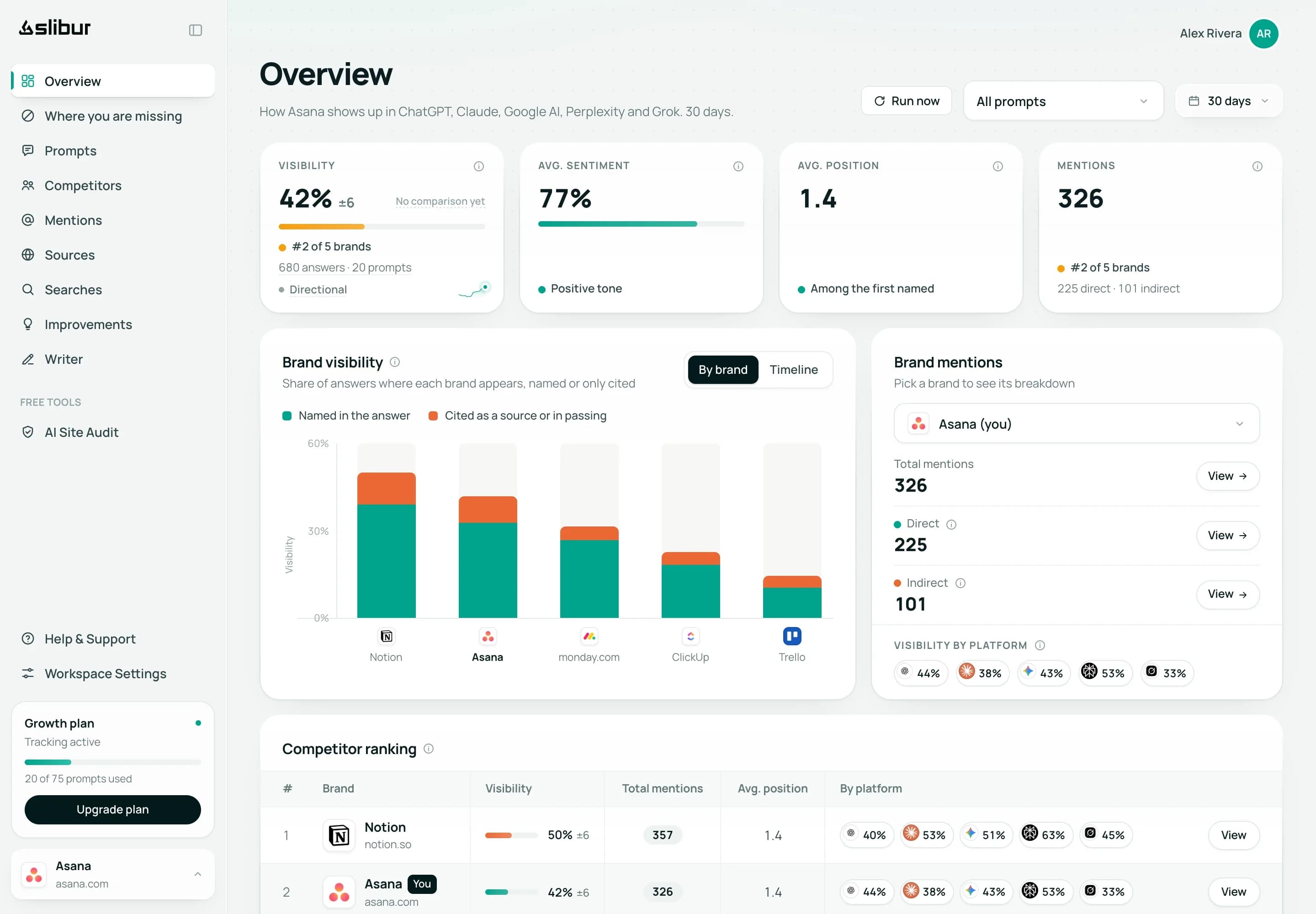
Visibility with its margin of error. How often the answers name you or cite your pages, split into direct and indirect mentions, with a 95% margin next to the figure and a label: directional or decision-grade. (checks 17 and 18)
Rivals and sources. Up to 25 competitors on the same prompts, and every cited URL marked as yours, a rival’s or a third party’s. (checks 19 and 20)
Position and tone. Where each answer places you in its list, and the tone of each mention, from a recommendation to a named drawback. (check 22)
History and alerts. Every answer kept, with 7, 30 and 90-day views. On paid plans, the weekly summary warns you when visibility falls by 10 points or more. (check 24)
And when the audit shows what to change, each week brings 3 improvement tasks on Starter, picked from a fixed list of 17 actions and tied to the pages that decide each question. The 18-point site audit is included too.
7 days free. No card required.
* On paid plans. ChatGPT is read on chatgpt.com in every country Slibur tracks except Venezuela and Puerto Rico, where it is asked weekly through its API.
What the trial includes
Run the answer half on your own questions for 7 days, free, with up to 10 prompts on all five AIs.
7 days free, no card. Sign up with your email or Google. When the trial ends, tracking stops and nothing is charged.
Up to 10 prompts. We suggest prompts and competitors from your website, and you edit the list before the first run.
All five AI platforms on day one. ChatGPT, Google AI Overviews, Claude, Perplexity and Grok answer your prompts as soon as your email is confirmed.
ChatGPT and Google AI again every day while you keep visiting your dashboard. Claude, Perplexity and Grok are asked once, at sign-up.
One “Run now” and the 18-point site audit. After the trial, our free GEO audit tool still audits any site, without an account.
On paid plans only: team invites and the weekly email summary with alerts.
* On paid plans. ChatGPT is read on chatgpt.com in every country Slibur tracks except Venezuela and Puerto Rico, where it is asked weekly through its API.
Slibur Starter
Track 20 prompts on 5 AI platforms
$59/ month (USD)
Or $602 billed yearly · save $106
Start your 7-day free trial7 days free. No card required.
- Up to 20 prompts, about 1,440 answers a month
- ChatGPT, Google AI Overviews, Claude, Perplexity, Grok
- ChatGPT and Google AI every day*, the other three every week
- Competitor ranking (up to 25 rivals) and every cited URL
- Weekly improvements, plus an email summary with alerts
- 18-point AI-readiness site audit
- Up to 2 team members
Need more prompts? Growth is $129 a month for 75 and Scale $299 for 250. Compare all plans
GEO checklist FAQ
About Slibur itself? Read the full FAQs or see every plan and price.
What is a GEO audit checklist?
The list of tests behind a generative engine optimization review. Half of it checks your site: can ChatGPT, Google’s AI Overviews, Claude, Perplexity and Grok reach your pages and use them? The other half checks the answers: what those AIs say about you when buyers ask. A useful one tells you how to test each item, not only what to aim for.
What should a generative engine optimization audit include?
A complete generative engine optimization checklist has two halves. The site: AI search crawlers allowed, Search Console’s generative AI setting on Include, key pages indexed with a snippet, the text in the HTML and pages worth quoting. The answers: 20 or more buyer questions asked three times on each AI, with mention rate, citation rate, rivals, cited pages, accuracy and tone recorded.
How is a GEO audit different from an SEO audit?
An SEO audit checks how your pages rank. A GEO audit adds what rankings cannot show: whether each AI’s own crawler may read you, and what the answers say, which brands they name and which pages they cite. Keep both. Google says its AI features are rooted in the same ranking and quality systems as Search, so SEO basics still decide whether a page is found.
Is a GEO checklist the same as an AEO checklist?
Close to it. AEO (answer engine optimization) and GEO name the same goal: being the source an AI answer uses. AEO checklists often stop at single pages, with direct answers and FAQs; a GEO checklist adds measuring your brand across several AIs. This one covers both, so you do not need a separate AEO audit checklist.
How many prompts should a GEO audit test?
At least 20 buyer questions, each asked three times on every AI you track. Across five AIs that is 300 answers, enough to read a 50% mention rate to within about 6 points either way at best. Fewer questions give a quicker read with a wider margin.
How often should you run a GEO audit?
The answer half every week, because the answers shift between runs. The site half after every release, migration or change to your firewall or CDN, plus a full pass every quarter. On paid plans, Slibur runs the answer half daily or weekly by itself.
Do I need llms.txt to pass a GEO audit?
No. Google says Search does not use llms.txt or other AI-only files, its AI features included. This checklist lists it and gives it 0 points. Publish one if you like; our llms.txt checker tests the format.
Does blocking GPTBot remove my site from ChatGPT?
Not from ChatGPT search. OpenAI treats the two as separate settings: GPTBot collects content for training, while OAI-SearchBot decides whether your pages can appear in ChatGPT search answers. Anthropic splits ClaudeBot from Claude-SearchBot the same way, and Google keeps Google-Extended apart from Googlebot.
Can a GEO audit be automated?
Most of it. Our free 18-point GEO audit tool runs parts of checks 1, 4, 5 and 11 on your homepage, with no account. On the answer half, Slibur asks your questions on five AIs and records mentions, citations, rivals, sources and tone by itself. Checking that the answers state your facts correctly still takes a person.
Will a perfect score get my brand cited?
No checklist can promise that, and no tool can buy you a spot in an AI answer. A perfect score means AI search can read you and you know where you stand. Whether you are named depends on what the AIs find about you across the web, and that is what the answer half measures.
Measure the half that keeps moving
You have the generative engine optimization audit checklist. The site half you fix once and recheck after each release. The answer half changes every week: Slibur asks your buyers’ questions on five AIs and shows who they name and cite, from day one of a 7-day trial.
7 days free. No card required.
By the Slibur team. Last reviewed .