Updated November 7, 2026
Perplexity visibility tracker
A Perplexity visibility tracker puts your buyers’ questions to Perplexity on a fixed schedule and logs, every time, whether it names your brand, how high, beside which rivals and which pages it cites. Slibur asks every prompt on Perplexity each week on paid plans, and the same plan covers ChatGPT, Google AI Overviews, Claude and Grok.
7 days free. No card required.
Slibur tracks ChatGPT
 Claude
 Google AI
 Perplexity
 Grok

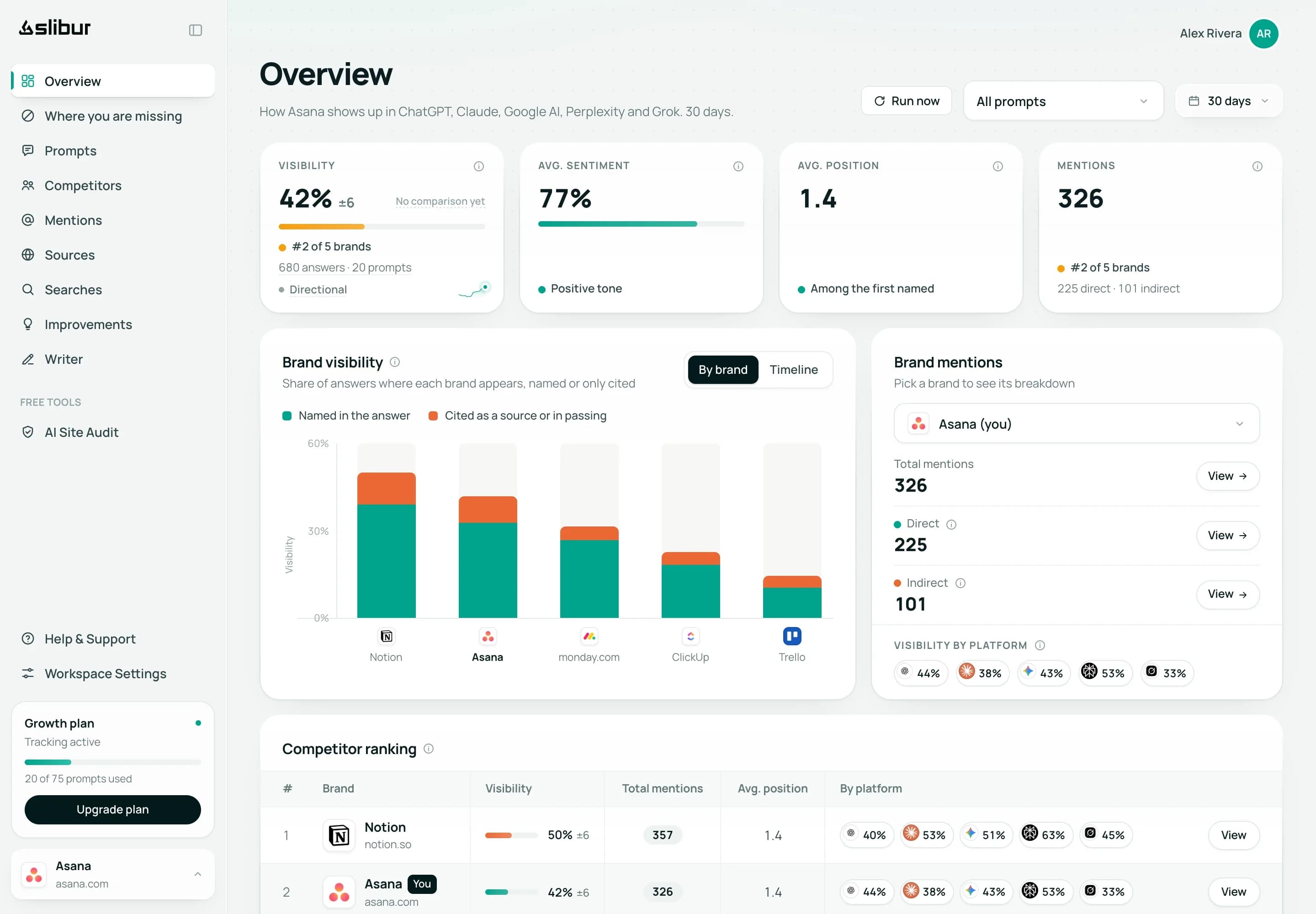
What a Perplexity tracker should log from every answer
Perplexity puts numbered sources next to its answers, so most of what you need is already on the screen. The hard part is reading it the same way, week after week, across every question. This is what Slibur keeps from each Perplexity answer.
Named, or not
Whether the answer text names your brand. Visibility, in Slibur, means the share of answers that name you or cite your site, per AI platform and overall.
How high
The order in which Perplexity lists brands. Slibur averages your place over the answers that include you, and does the same for each rival.
Cited, not named
Perplexity often quotes a page as evidence and then recommends somebody else. Slibur logs that as an indirect mention, so a page that feeds the answer is never confused with a brand that wins it.
Every source, sorted
Each page Perplexity lists is tagged as yours, a competitor’s or a third party’s, and Sources ranks the domains it relies on across all your prompts.
Tone
Whether Perplexity speaks well or badly of each brand it names. Praise needs a clear recommendation and criticism an explicit drawback; anything short of that counts as a plain mention.
Not logged
The web searches Perplexity runs before it writes. Slibur stores those for ChatGPT, not for Perplexity.
Sources work the same way on all five AI platforms; see how AI citation tracking reads them side by side.
We asked Perplexity for the best Perplexity visibility tracker, five times
On we put one question to Perplexity five times in under a minute, with the same request Slibur’s tracker sends: “What is the best Perplexity visibility tracker?” None of the top Google results we read shows how Perplexity answers this very question from one run to the next.
14
tools named across the five answers. Only Otterly.AI, Profound and Peec AI came up every time.
3 to 12
tools per answer. Three answers named four or fewer; the other two named ten or more.
20 of 33
cited pages came back in all five runs. The sources held far steadier than the names.
1 of 9
pages in Google’s US top 10 for this search made it into Perplexity’s sources.
“What is the best Perplexity visibility tracker?”
Asked five times on . The number is the order in which each answer named the tool.
| Tool | Run 1 | Run 2 | Run 3 | Run 4 | Run 5 | Runs |
|---|---|---|---|---|---|---|
| Otterly.AI | Named 6 | Named 1 | Named 1 | Named 1 | Named 1 | 5 |
| Profound | Named 4 | Named 2 | Named 2 | Named 2 | Named 3 | 5 |
| Peec AI | Named 5 | Named 4 | Named 3 | Named 4 | Named 11 | 5 |
| LLMrefs | Named 7 | Named 3 | Not named | Named 3 | Named 7 | 4 |
| RadarKit | Named 1 | Not named | Not named | Not named | Named 2 | 2 |
| Leapd | Named 2 | Not named | Not named | Not named | Named 8 | 2 |
| AY Rank | Named 10 | Not named | Not named | Not named | Named 5 | 2 |
| SE Ranking | Named 8 | Not named | Not named | Not named | Named 10 | 2 |
Named in one run: Rankshift and AIclicks (run 1); Amplitude, GEOflux, Wellows and Cloro (run 5).
Same sources, different shortlist. Runs two to four named three or four tools. Runs one and five named ten and twelve, from nearly the same pages: 20 of the 33 sources came back every time. Check once and you could have walked away with any of those lists.
Cited is not named. GetIntel’s comparison of Perplexity trackers was cited in all five runs, and GetIntel was never named. HubSpot’s AI visibility product page was cited every time too, and HubSpot was not named once. Count only citations and both would look like winners here.
Named, but never cited. Otterly.AI came first in four of the five answers and Profound was named in all five, yet neither brand’s own website was among the sources. Their place came from other people’s pages: 17 of the 20 pages cited every time were “best tools” roundups.
Google’s first page is a different list. Of the nine pages Google’s US top 10 showed for this search the same day, eight never made it into Perplexity’s sources. Ranking on page one of Google did not, on its own, earn a citation here.
Slibur was not in any of them. Not named and not cited, in five runs. That is the starting point a tracker makes visible. The pages Perplexity cited every time are where the work begins, and our guide on how to rank on Perplexity covers what to do with them.
One morning, one question. This is a snapshot from one country, in one language. A trend needs every prompt asked again week after week, and our methodology explains how Slibur handles the margin of error.
The pages cited in all five runs
The 20 pages came from Sona (two pages), TrackMyVisibility, AY Rank, GetIntel, Rankshift, Winston Digital Marketing, Wellows, GrowByData, Leapd, InsideA, SEO Turtle, HubSpot (two pages), Amplitude (two pages), Peec AI, GEOflux, an article on LinkedIn and a post on dev.to. Every answer listed between 25 and 27 sources.
How we asked
Each run went through OpenRouter to Perplexity’s Sonar model, with Perplexity’s own web search, located in the United States, in English and with no brand in the question. The five answers arrived between 12:19 and 12:20 UTC. Names were read by hand, one per vendor, in the order each answer first presents them; products count under their maker (Alex under Leapd, SE Visible under SE Ranking). A line in the first answer about an unnamed free tracker was not counted, and the answer texts are not reproduced here.
Perplexity rank trackers compared: price, cadence and method
Seven tools that track Perplexity, with what the cheapest plan that includes it gives you. Slibur’s row is from our own pricing and methodology; every other row comes from that tool’s own pages, read on November 7, 2026. Prices are monthly.
Scroll sideways to see every column.
| Tool | Entry plan with Perplexity | How often it asks Perplexity | How it asks Perplexity | Other AI platforms in that plan |
|---|---|---|---|---|
| SliburStarterOur product | $59 a month, 20 prompts | Every week, every prompt | Perplexity’s Sonar API through OpenRouter, with Perplexity’s own web search | ChatGPT and Google AI Overviews every day*, Claude and Grok every week, all included |
| GetIntelMonitorPer its website, read November 7, 2026 | $29 a month, 25 buyer questions | Every day | The Perplexity interface, not an API, per its Perplexity page | ChatGPT, Gemini and Google AI Overviews. Claude only on Growth ($149), weekly. No Grok listed |
| Otterly.AILitePer its website, read November 7, 2026 | $29 a month, 15 prompts | Every day | Not stated on its pricing page | ChatGPT, Google AI Overviews and Microsoft Copilot. Claude, Google AI Mode and Gemini as paid add-ons. No Grok listed |
| LLM PulseStarterPer its website, read November 7, 2026 | €49 a month (shown as about $58), 50 prompts | Every week; daily tracking from €79 a month | Says it tracks Perplexity Pro responses | ChatGPT, Gemini, Google AI Mode and Google AI Overviews. Claude and Grok as paid add-ons |
| RendixGrowthPer its website, read November 7, 2026 | $85 a month, 50 prompts | Three times a week (Monday, Wednesday, Friday) | Perplexity’s API, sonar model with web search on | ChatGPT, Gemini and Google AI Overviews. Claude or Grok listed as coming soon, at $50 a month per model for every 50 prompts |
| Peec AIStarter, plus PerplexityPer its website, read November 7, 2026 | $95 a month for 3 models, plus $30 a month to add Perplexity, 50 prompts | Every day | Not stated on its pricing page | Three of ChatGPT, Google AI Mode, Google AI Overviews, Microsoft Copilot, Gemini and Naver AI. Claude and Grok, through their APIs, on Enterprise |
| SearchableProPer its website, read November 7, 2026 | $125 a month, 100 prompts per model | Every day | The Perplexity app, per the data note in its guide to Perplexity trackers | ChatGPT and Google AI Overviews. Claude, Grok and five more as paid add-ons |
* On paid plans. ChatGPT is read on chatgpt.com in every country Slibur tracks except Venezuela and Puerto Rico, where it is asked weekly through its API.
What only Slibur includes. Claude and Grok at the entry price. Every other plan in the table leaves them out, sells them as extras or keeps them for a higher tier.
Where others are ahead. Four of the six ask Perplexity every day and Rendix three times a week; Slibur asks it weekly and spends its daily runs on ChatGPT and Google AI Overviews. LLM Pulse, Rendix and Peec AI start at 50 prompts and Searchable at 100, against 20 on Slibur Starter. GetIntel’s entry plan lists an API and a Looker Studio connector; Slibur has neither.
Check what the first price buys. Peec AI’s $95 Starter does not include Perplexity: it is a $30 extra on that plan. LLM Pulse charges in euros, and its daily option starts at €79. GetIntel adds Claude only on its $149 plan.
See what AI can read on your website
We run 18 checks on what helps AI assistants find, read and cite your site, and tell you what to fix first.
Ready as soon as you sign up, included in the free trial.
No account? Free GEO audit tool: the same 18 checks, without signing up.
Perplexity tracker checklist: 12 questions to score any tool
Run it on every tool you trial, ours included. Each yes is one point. Slibur’s answers sit under each question, taken from how the product works today: it scores 10 of 12, and the two misses are listed as plainly as the rest.
Does it ask your buyers’ questions, without your brand name in them?
A question that names you only tests whether Perplexity knows you, not whether it recommends you.
Slibur: yes. It proposes prompts from your website, never with your own brand in them, and you can change every one before the first run. For ideas, our free AEO prompts generator writes twenty.
Does it count mentions and citations separately?
Perplexity can cite your page and recommend a rival in the same answer, as the five runs above show.
Slibur: yes. Direct mentions and indirect ones (cited, not named) are counted apart.
Is every cited source tagged as yours, a rival’s or a third party’s?
Pages run by others that recommend your competitors are usually where the work starts.
Slibur: yes. Every source is tagged, and Sources ranks those domains across all your prompts.
Does it ask from your buyers’ country, in their language?
Perplexity searches the web for each question, and a search from another country can surface other pages.
Slibur: yes. Each workspace is set to one of 40 countries and 7 languages, and Perplexity is asked from there.
Does it say how, and how often, it asks Perplexity?
Mixing app and API answers, or changing the schedule, can move a score when nothing real changed.
Slibur: yes. Through the Sonar API, every week on paid plans, as our methodology sets out.
Does it keep each answer in full?
A score you cannot check against the words Perplexity used is hard to trust.
Slibur: yes. Every answer is stored whole, and you can look back 7, 30 or 90 days.
Does it wait for evidence before it alerts you?
Five runs of one question gave five different shortlists. One odd week is not a trend.
Slibur: yes. Alerts must pass a statistical test, and those for Perplexity begin only after 8 weekly runs.
Does it tell you what to do next?
Numbers without a next step end up in a report nobody acts on.
Slibur: yes. Improvements hands you three tasks a week on Starter, and the Writer drafts a page for a question you pick (5 a month on Starter).
Does the same plan cover the other AI platforms your buyers use?
Each platform picks its own sources, so a good week on Perplexity says little about ChatGPT.
Slibur: yes. Every plan, Starter included, asks Perplexity alongside ChatGPT, Google AI Overviews, Claude and Grok.
Can you try it on your own prompts without a card?
Your category is the only test that counts. A demo account shows somebody else’s.
Slibur: yes. 7 days, up to 10 prompts, no card. Perplexity answers on the day you sign up.
Does it keep the searches Perplexity ran before answering?
They show which web searches your pages need to win.
Slibur: no. It records them for ChatGPT only.
Can you export the data or pull it through an API?
Agencies and data teams often want the rows, not only the dashboard.
Slibur: no. It has no exports, API or integrations today.
Slibur’s score
10 / 12
The two misses: it does not keep Perplexity’s own searches, and it has no exports or API. Per their websites, read November 7, 2026, Rendix keeps the searches Perplexity runs, and GetIntel and Searchable list API access on their entry plans.
Score the others in your trials the same way: one point for each plain yes.
How Slibur asks Perplexity, and why it uses the API
One method for every brand you track, yours and your rivals’, written down so you can check it.
The Sonar API, with Perplexity’s own search. Every prompt goes to Perplexity’s Sonar model through OpenRouter. Perplexity searches the web itself and returns its answer with the sources it used, from your workspace’s country.
Why not the app. Perplexity’s help center (opens in a new tab) says Pro Search kicks in automatically when the asker’s plan includes it, and that the model can be left on Best or picked from a menu. Two buyers asking the same thing can get answers built in different ways. The API gives your brand and every rival one baseline.
Every week, every prompt. On paid plans Perplexity answers each of your prompts once a week. ChatGPT and Google AI Overviews are the two read every day*. In the trial, Perplexity is asked once, when you sign up.
Alerts that wait. The weekly reading compares Perplexity’s latest 4 runs with the 4 before, and its alerts begin after 8 weekly runs, so one strange answer never sends you an email.
A flag when Perplexity trails. If Perplexity is your weakest AI platform and names you at least 25 points less often than your strongest, Improvements flags it that week and sends you to the pages it cites.
Only Perplexity, when you want it. Choose Perplexity in the platform filter and Mentions and Sources show nothing but its answers. Each of up to 25 competitors gets its own Perplexity figure too.
The other four come with it
Buyers move between assistants, and each one leans on its own pages. Every Slibur plan asks all five, so you see where Perplexity agrees with the others and where it stands alone.
- PerplexityEvery week
- ChatGPTEvery day*
- Google AI OverviewsEvery day*
- ClaudeEvery week
- GrokEvery week
The ChatGPT side is on the ChatGPT visibility tracker page, Google’s on the AI Overview tracker page, and all five together on our AI visibility tool page.
* On paid plans. ChatGPT is read on chatgpt.com in every country Slibur tracks except Venezuela and Puerto Rico, where it is asked weekly through its API.
Put your own prompts to Perplexity, free for 7 days
Perplexity and the other four AI platforms answer on the day you sign up, so you see who gets named in your category before you pay anything.
7 days free, no card. Sign up with your email or Google. When the trial ends, tracking stops and nothing is charged.
Up to 10 prompts. We suggest prompts and competitors from your website, and you edit the list before the first run.
All five AI platforms on day one. ChatGPT, Google AI Overviews, Claude, Perplexity and Grok answer your prompts as soon as your email is confirmed.
ChatGPT and Google AI again every day while you keep visiting your dashboard. Claude, Perplexity and Grok are asked once, at sign-up.
One “Run now” and the 18-point site audit. After the trial, our free GEO audit tool still audits any site, without an account.
On paid plans only: team invites and the weekly email summary with alerts.
* On paid plans. ChatGPT is read on chatgpt.com in every country Slibur tracks except Venezuela and Puerto Rico, where it is asked weekly through its API.
Slibur Starter
Track 20 prompts on 5 AI platforms
$59/ month (USD)
Or $602 billed yearly · save $106
Start your 7-day free trial7 days free. No card required.
- Up to 20 prompts, about 1,440 answers a month
- ChatGPT, Google AI Overviews, Claude, Perplexity, Grok
- ChatGPT and Google AI every day*, the other three every week
- Competitor ranking (up to 25 rivals) and every cited URL
- Weekly improvements, plus an email summary with alerts
- 18-point AI-readiness site audit
- Up to 2 team members
Need more prompts? Growth is $129 a month for 75 and Scale $299 for 250. Compare all plans
Where these facts come from
What we say about Perplexity and the other tools comes from these pages and runs, on November 7, 2026. The Reddit thread in Google’s top 10 refused our request, so it is not used here.
Perplexity, read November 7, 2026
- Perplexity crawlers: PerplexityBot and Perplexity-User (opens in a new tab)
- How does Perplexity work? (Perplexity Help Center) (linked where we quote it, under how Slibur asks Perplexity)
The five Perplexity runs, November 7, 2026
- “What is the best Perplexity visibility tracker?”, asked by Slibur through OpenRouter, model perplexity/sonar, located in the United States (12:19 to 12:20 UTC)
- Low search context, as Slibur’s tracker sends it by default (answer texts not reproduced)
Other tools’ own pages, read November 7, 2026
- GetIntel: pricing page and Perplexity tracking page
- Otterly.AI: pricing page
- LLM Pulse: pricing page and Perplexity page
- Rendix: pricing page and Perplexity page
- Peec AI: pricing page
- Searchable: pricing page and its guide to Perplexity rank tracking tools (for how it reads Perplexity)
Slibur’s figures come from the product itself: plans and prices on our pricing page, and how each AI is read, how often and when alerts fire in the methodology.
Questions about tracking Perplexity
About Slibur itself? Read the full FAQs or see every plan and price.
What is a Perplexity visibility tracker?
Software that runs the same list of buyer questions through Perplexity at set intervals, saves each answer and works out how often you are named or cited, how high, and beside which rivals. The repetition is the point: when we asked Perplexity one question five times on November 7, 2026, it named anywhere from 3 to 12 tools.
How do I track brand mentions in Perplexity?
Write the questions a buyer types before they have heard of you, put each one to Perplexity logged out, and note which brands come up, in what order, and which pages are listed as sources. Repeat on other days, because the shortlist moves between runs.
Past a few dozen answers that turns into a weekly chore. On paid plans Slibur asks every prompt on Perplexity each week, stores each answer whole and tags every source as yours, a rival’s or a third party’s.
Is there a free Perplexity visibility tracker?
Tracking by hand costs nothing: a private window, your buyers’ questions and a spreadsheet. Slibur’s 7-day trial needs no card and puts up to 10 of your prompts to Perplexity, ChatGPT, Google AI Overviews, Claude and Grok from the first day. Without signing up, the GEO audit tool page runs the 18-point site audit, which checks whether AI crawlers such as PerplexityBot can read your pages. Paid Slibur plans begin at $59 a month, on Starter.
Does Slibur read Perplexity’s app or its API?
The API: Perplexity’s Sonar model through OpenRouter, with Perplexity doing its own web search from your workspace’s country. In the app, Pro Search and the model in use depend on each person’s plan and settings, so there is no single app answer to measure. The API gives every brand you track the same baseline, and the method is published on our methodology page.
How often does Slibur check Perplexity?
Once a week for every prompt on paid plans, and once at sign-up during the free trial. Daily reading is kept for ChatGPT and Google AI Overviews. If you need Perplexity itself checked every day, the comparison table above lists four tools whose entry plans do that.
How much does Perplexity tracking cost?
Among the seven tools above, entry plans that include Perplexity ran from $29 a month (GetIntel and Otterly.AI) to $125 (Searchable, or Peec AI with Perplexity added), read on November 7, 2026. Slibur Starter costs $59 a month and puts 20 prompts to all five AI platforms. Compare what each price buys: prompts, how often Perplexity is asked and which other platforms come with it.
Do trackers see Perplexity Pro answers?
It depends on the tool. LLM Pulse says on its Perplexity page that it tracks Perplexity Pro responses. Slibur measures the API answer instead, because in the app Pro Search and the model depend on each person’s plan and settings, and your buyers are not all on the same one.
How is tracking Perplexity different from tracking ChatGPT?
Perplexity searches the web for every question and prints numbered sources beside its answer, so there is always a list of pages to count. In Slibur, ChatGPT is read on chatgpt.com every day on paid plans (once a week by API in Venezuela and Puerto Rico) and the searches it ran are stored too; Perplexity goes through its Sonar API once a week, without those searches. A brand can do well on one and poorly on the other, which is why both sit in the same plan.
How do I get Perplexity to recommend my brand?
No tracker can promise a place in its answers. In the five runs above, the brands named every time owed it to other people’s pages: 17 of the 20 pages cited in every run were “best tools” roundups. Start by letting PerplexityBot read your site, then look at the pages Perplexity already cites for your buyers’ questions and work on being listed there, and give each question a page of your own with a plain, direct answer. Our guide on ranking on Perplexity covers each step.
Can Perplexity read my website?
Perplexity says PerplexityBot is the crawler that lets sites show up in its results, and it recommends allowing it in robots.txt and accepting requests from its published IP ranges. A firewall or bot filter can still block it when robots.txt allows it. Our free AI crawler checker shows whether robots.txt lets it in.
By the Slibur team. Last reviewed .
See who Perplexity names in your market
Enter your website: Slibur proposes the questions and competitors to follow, and your Perplexity visibility tracker gives its first readings on day one, beside ChatGPT, Google AI Overviews, Claude and Grok.
7 days free. No card required.